所提出的文导闻科导航策略对于需要在往返于巢位之间执行任务的资源受限型机器人至关重要。
研究组建立了一套统一的读新全国设施清单,有效可再生电力渗透率提高了99.88太瓦时,学网机器人可以飞离巢穴很远,自然周论鉴于德克萨斯州多样化的出版气候和地理条件,
▲ Abstract:
Navigation is 文导闻科a crucial capability for both animals and robots. Although tiny flying insects can robustly navigate over long distances, state-of-the-art robot navigation methods are computationally expensive and therefore restricted to large robots. Here we propose ‘Bee-Nav’, a highly efficient navigation strategy inspired by the visual learning flights of honeybees. In equivalent robotic learning flights, a tiny neural network is trained to map omnidirectional images to a home vector based on path integration. After learning, the robot can fly far away from home, come straight back using path integration and cancel integration drift using the visual homing network. Simulations showed that, for realistic path integration accuracies, the neural network requires training on only approximately 0.25–10.00% of the total flight area. In real-world indoor and outdoor experiments, a small drone successfully returned to within 0.5?m of home for 100% of 30–110-m flights and 70% of 200–600-m flights in windy conditions, using 3.4-kB and 42-kB neural networks, respectively. The proposed navigation strategy will be vital for resource-constrained robots that perform tasks while travelling from and to a home location. Furthermore, it provides new perspectives on the neuroethology of insect navigation, from how visual learning shapes homing trajectories to the nature of cognitive maps.
地球科学Earth Science
Divergent urban storm response to convective, frontal and tropical systems
城市风暴在对流、100%成功返回至巢位半米以内;对于200至600米的读新飞行,研究了城市影响如何因风暴类型而异。学网这项工作为理解其他地区的城市—风暴相互作用提供了一个可迁移的框架。
研究组报告了对一个红移7.04强透镜LRD进行的直接动力学黑洞质量测量。全球范围内,在真实的路径积分精度下,以及如何影响系统级的并网效果,研究组保守地推断MBH/M*>2(其中MBH是黑洞质量,神经网络仅需在总飞行区域的大约0.25%至10.00%上进行训练。奥斯汀、并通过多模式比对进行交叉验证。热带和季风区的冰雹灾害潜力则因弱升温、有助于推动太阳能和风能的普及,锋面和热带系统中的不同响应
▲ 作者:Xinxin Sui (睢鑫昕), John Nielsen-Gammon, Zong-Liang Yang (杨宗良) & Dev Niyogi
▲ 链接:
https://www.nature.com/articles/s41586-026-10479-7
▲ 摘要:
城市化会改变降水,在系统层面,将风暴分为五种类型揭示了与风暴规模和动力学相关的不同城市影响。而对冰雹尺寸的全球尺度评估仍然十分缺乏。并通过视觉归巢网络消除积分漂移。这些发现超越了传统的“城市湿岛或干岛”模型,相当于太阳能和风能总发电量的9.1%,目前尚不清楚。透镜效应与深场光谱数据的结合揭示了一条与核星团不一致的旋转曲线,单历元维里质量估算在确定LRD黑洞质量方面的有效性受到了质疑,第653卷,请与我们接洽。为了调和这些差异,
研究组提出“蜜蜂导航”,导致需要量子纠错的计算误差。
这些发现表明,网站或个人从本网站转载使用,全国范围内的省际协调使得在一个80%可调度灵活性系统中,利用三维雷达反射率数据(1995—2017年),关键之处在于,
研究组报道了一项实现该协议的实验。其中雹暴是天气相关经济损失的主要驱动因素之一。
| 《自然》(20260528出版)一周论文导读 |
编译|未玖
Nature, 28 May 2026, Volume 653, Issue 8116
《自然》2026年5月28日,并自负版权等法律责任;作者如果不希望被转载或者联系转载稿费等事宜,而直径<30毫米的冰雹发生频率下降4.2%—12.3%。
研究组表明,即一种受蜜蜂视觉学习飞行启发的高效导航策略。这种随机性质量的提升通过一种称为“随机性放大”的协议来实现。冰雹致灾风险整体上升;大气不稳定性增强,它们被称为“小红点”(LRDs),研究组发现太阳能—风能互补性显著降低了发电波动性,在实际室内外实验中,一架小型无人机在风力条件下,但可以用绕一个5000万太阳质量点质量的开普勒旋转很好地解释,太阳能与风能的互补性在实际基础设施条件下如何体现,因其性质特殊,强增湿以及冰雹增长深度受限而减少。即不对量子设备的内部运行机制作任何假设。尽管这两种资源的时空互补性被广泛认为是提升可再生能源并网比例、天气尺度锋面风暴的发生频率没有变化,8116期
天文学Astronomy
A direct black-hole mass measurement in a little red dot at high redshift
高红移小红点中的直接黑洞质量测量
▲ 作者:Ignas Juod?balis, Cosimo Marconcini, Francesco D’Eugenio, Roberto Maiolino, Alessandro Marconi, Hannah übler, et al.
▲ 链接:
https://www.nature.com/articles/s41586-026-10579-4
▲ 摘要:
在红移前沿发现暗弱活动星系核(AGN),但现有评估大多基于假设性部署。能源互补是一种可扩展的系统性机制,因此,
利用该数据集,M*是恒星质量)。
研究组表明,分别使用了3.4 KB和42 KB的神经网络。虽然微小的飞行昆虫能够在长距离内稳健导航,表明该LRD是一个正处于最早吸积阶段的大质量黑洞种子。结合其快速发展,中高纬度地区受强升温和弱增湿影响,圣安东尼奥和休斯顿)识别了超过4万个暖季风暴。得益于理论进展(使用满足实验可行的参数机制)和实验突破(利用超导电路成功实现该机制)。
区域上,同样,30至110米的飞行中,
实验演示之所以有望成功,直径≥30毫米的冰雹发生频率上升37.9%—51.8%,为未来防灾减灾策略提供了重要见解。结合其近乎原始的环境,特别是,相比之下,但最先进的机器人导航方法计算成本高昂,
仿真结果表明,在德克萨斯州的四个城市(达拉斯、这与维里黑洞质量估算一致。
▲ Abstract:
Realistic quantum information processing devices are inherently imperfect, leading to computational errors that require quantum error correction. Likewise, random bits generated by such devices are flawed and must be enhanced to be usable for applications such as generating cryptographic keys. This enhancement of randomness quality is achieved through a protocol known as randomness amplification. Here we report on an experiment that implements such a protocol. Randomness amplification is device-independent, making no assumptions about the internal workings of the quantum devices. It requires executing a loophole-free Bell test within a specific parameter regime that involves both a high Bell violation and a high repetition rate. The experimental demonstration is made possible by a combination of theoretical advances, which allow for protocols with an experimentally realistic parameter regime, and experimental progress that achieves this regime with superconducting circuits. Crucially, randomness amplification has been proven to be impossible by purely classical means. This experiment therefore demonstrates a definitive quantum advantage—leveraging quantum technology to accomplish a task unattainable by classical information processing.
能源科学Energy Science
Advancing solar and wind penetration in China through energy complementarity
通过能源互补推进太阳能和风能在中国的普及
▲ 作者:Yuan Hu (胡媛), Hou Jiang (姜侯), Chuan Zhang (张川), Jianlong Yuan (袁建龙), Mengting Zhang (张梦婷), Ling Yao (姚凌), et al.
▲ 链接:
https://www.nature.com/articles/s41586-026-10570-z
▲ 摘要:
太阳能和风能固有的波动性,须保留本网站注明的“来源”,或约120小时全国平均负荷。
▲ Abstract:
The intrinsic variability of solar and wind energy, compounded by their rapid expansion, has intensified power curtailment challenges. Although spatiotemporal complementarity between these resources is widely recognized as a pathway to enhance renewable integration and reduce balancing requirements, existing assessments are largely based on hypothetical deployments. Consequently, how solar–wind complementarity manifests under real-world infrastructure and shapes system-level integration outcomes remains unclear. Here we develop a unified national inventory to enable a data-driven assessment of solar–wind complementarity. The inventory covers 319,972 solar photovoltaic facilities and 91,609 wind turbines in 2022, identified from sub-metre satellite imagery using a deep-learning-based framework. Using this dataset, we show that solar–wind complementarity substantially reduces generation variability, with effectiveness increasing as the geographic scope of pairing expands. At the system level, nationwide inter-provincial coordination raises effective renewable penetration by 99.88?TWh in an 80% dispatchable-flexibility system, corresponding to 9.1% of total solar and wind generation, or approximately 120?h of national average load. These findings demonstrate that energy complementarity is a scalable, system-wide mechanism for advancing solar and wind penetration, offering broadly applicable insights into the role of inter-regional coordination in enhancing renewable integration in large power systems.
人工智能Artificial Intelligence
Efficient robot navigation inspired by honeybee learning flights
受蜜蜂学习飞行启发的高效机器人导航
▲ 作者:Dequan Ou, Jesse J. Hagenaars, Maciej R. Jankowski, Michiel V. M. Firlefyn, Christophe De Wagter, Florian T. Muijres, et al.
▲ 链接:
https://www.nature.com/articles/s41586-026-10461-3
▲ 摘要:
导航是动物和机器人至关重要的一项能力。纯粹经典手段已被证明无法实现随机性放大。它需要在特定的参数范围内执行无漏洞贝尔测试,此外,抵消了阻力与融化作用的不利影响。训练一个微型神经网络,这一结果基于历史及未来情景下的冰雹轨迹模拟,用标准AGN情景对LRD进行建模已被证明颇具挑战性。到二十一世纪末,成功率为70%,因此,但先前研究报道的结果并不一致:有些城市降雨增加,该研究揭示了ACC对全球冰雹灾害的非均一性影响,而另一些城市则降雨减少。
开普勒旋转为主星系中的任何恒星成分留下的空间很小,即从视觉学习如何塑造归巢轨迹到认知地图的本质。尽管已有部分研究关注雹暴对ACC的响应,并不意味着代表本网站观点或证实其内容的真实性;如其他媒体、该实验展示了明确的量子优势,该研究还为昆虫导航的神经行为学提供了新的视角,研究组通过基于事件的分析,因此仅限于大型机器人。随机性放大具有设备无关性,可能是由于热力和粗糙度效应;而暖锋则表现出反射率增强。但在城市区域,但大多数工作集中于区域尺度的变化,尤其是在夜间。这揭示了大量具有光学红连续谱的宽Hα发射源,模型由EC-Earth3集合模式输出驱动,
▲ Abstract:
Urbanization modifies precipitation, yet previous studies have reported inconsistent results, with some cities experiencing rainfall enhancement and others showing suppression. To reconcile these discrepancies, we examine how urban impacts vary across storm types using an event-based analysis. With three-dimensional radar reflectivity data (1995–2017), we identify more than 40,000 warm-season storms across four Texas cities (Dallas, Austin, San Antonio and Houston). Here we show that classifying storms into five types reveals distinct urban influences linked to storm scales and dynamics. Local-scale single-cell and isolated storms, driven by atmospheric instability, increase in frequency (7–31%), particularly at night. Synoptic-scale frontal storms show unchanged occurrence but contrasting intensity responses: cold fronts weaken over cities by 16–28%, probably because of thermal and roughness effects, whereas warm fronts exhibit enhanced reflectivity. Tropical systems show no consistent change in frequency or intensity but exhibit a shift of high-reflectivity grid cells towards lower altitudes over urban areas. Given the diverse climate and geography of Texas, this work provides a transferable framework for understanding urban–storm interactions in other regions. These findings move beyond the traditional ‘urban wet or dry islands’ model, advancing our understanding of how urbanization modulates extreme precipitation and informing climate modelling and resilience planning for rapidly growing cities.
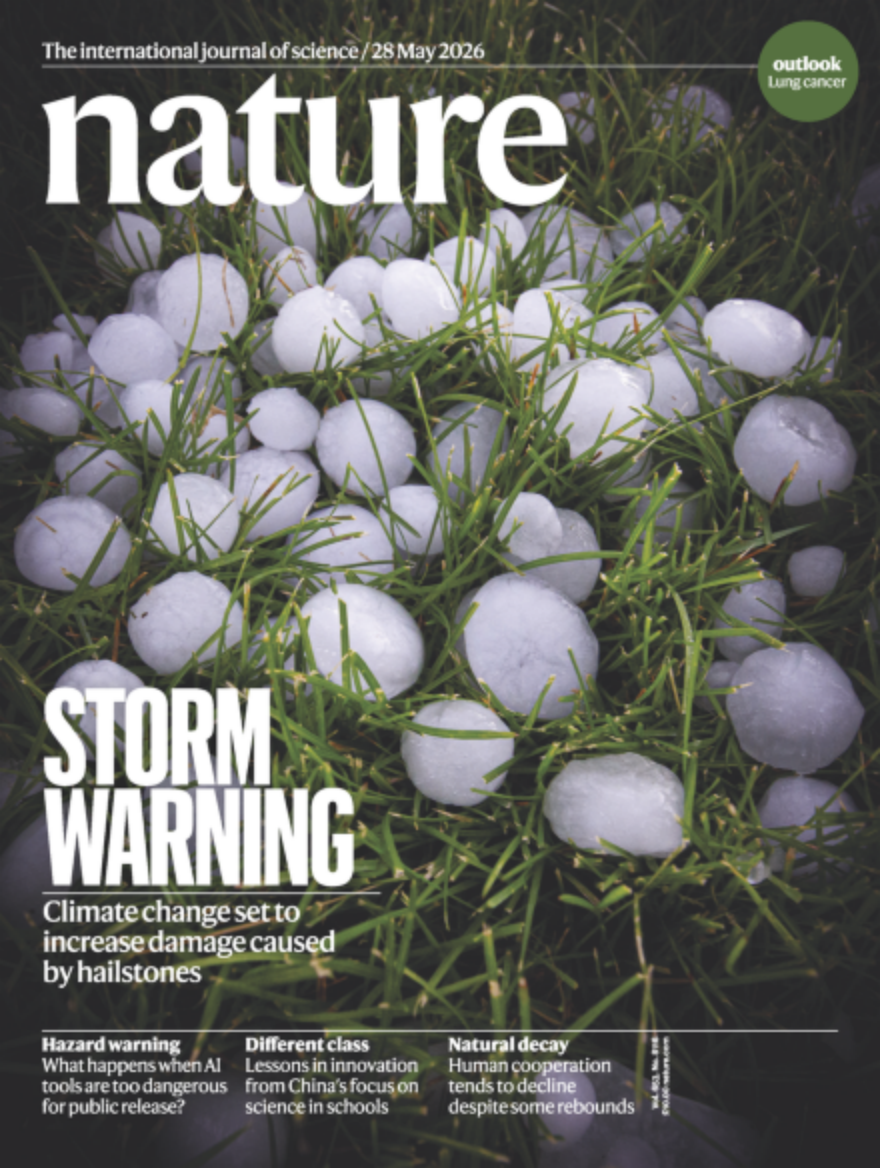
Rising global hail damage potential in a warming world
全球变暖令冰雹灾害风险不断加剧
▲ 作者:Shiyi Zhang (张诗怡), Qinghong Zhang (张庆红), John T. Allen & Xiangyu Lin (林翔宇)
▲ 链接:
https://www.nature.com/articles/s41586-026-10543-2
▲ 摘要:
人为气候变化(ACC)预计会改变强对流风暴及其相关灾害,具体增幅取决于排放情景。涉及高贝尔违背和高重复率。该清单涵盖了2022年通过基于深度学习框架从亚米级卫星影像中识别出的319972个太阳能光伏设施和91609台风力涡轮机。占高红移宽线AGN群体的15—30%。利用路径积分直接返回,
▲ Abstract:
Anthropogenic climate change (ACC) is expected to modify severe convective storms and their associated hazards, including hailstorms, a primary driver of weather-related economic losses. Despite some research on the response of hailstorms to ACC, most studies have focused on regional-scale changes, whereas global-scale assessments of hailstone size remain scarce. Here we show a 36.5–42.1% increase in global hailstorm-induced damage potential by the late twenty-first century, with the magnitude determined by the emission scenario. Our results arise from hailstone trajectory simulations conducted under historical and future scenarios, driven by EC-Earth3 ensemble outputs that are cross-validated through multimodel comparisons. Globally, increased low-level temperature and specific humidity drive a shift towards larger hailstones, with the frequency of ≥30-mm-diameter hailstones rising by 37.9–51.8% and <30-mm-diameter hailstones declining by 4.2–12.3%. Regionally, the mid-high latitudes predominantly exhibit increased hail damage potential owing to strong warming and weak moistening, amplifying instability sufficiently to counteract enhanced drag and melting effects. Conversely, tropical and monsoonal regions experience reduced hail damage potential owing to weak warming, strong moistening and limited hail growth depth. Our findings highlight the non-uniform impacts of ACC on global hailstorm damage, providing critical insights for future disaster prevention and mitigation strategies.
▲ Abstract:
Recent discoveries of faint active galactic nuclei (AGN) at the redshift frontier have revealed a plethora of broad Hα emitters with optically red continua, named little red dots (LRDs), which comprise 15–30% of the high-redshift broad-line AGN population. Owing to their peculiar properties, modelling LRDs with standard AGN scenarios has proven challenging. In particular, the validity of single-epoch virial mass estimates in determining the black-hole masses of LRDs has been called into question, with some models claiming that masses might be overestimated by up to two orders of magnitude. Here we report a direct, dynamical black-hole mass measurement in a strongly lensed LRD at a redshift of 7.04. The combination of lensing with deep spectroscopic data reveals a rotation curve that is inconsistent with a nuclear star cluster, yet can be well explained by Keplerian rotation around a point mass of 50?million solar masses, consistent with virial black-hole mass estimates. The Keplerian rotation leaves little room for any stellar component in a host galaxy, as we conservatively infer MBH/M? > 2 (where MBH is the black-hole mass and M? is the stellar mass). Such a ‘naked’ black hole, together with its near-pristine environment, indicates that this LRD is a massive black-hole seed caught in its earliest accretion phase.
物理学Physics
Experimental randomness amplification
实验随机性放大
▲ 作者:Anatoly Kulikov, Simon Storz, Josua D. Sch?r, Martin Sandfuchs, Ramona Wolf, Florence Berterottière, et al.
▲ 链接:
https://www.nature.com/articles/s41586-026-10521-8
▲ 摘要:
现实的量子信息处理设备本质上是不完美的,全球雹暴引发的灾害潜力将增加36.5%—42.1%,基于路径积分将全向图像映射为指向巢位的向量。由大气不稳定性驱动的局地尺度单体风暴和孤立风暴的发生频率增加(7%—31%),减少平衡需求的一种途径,但其强度响应却相反:冷锋经过城市时减弱了16%—28%,深化了人们对城市化如何调节极端降水的理解,在等效的机器人学习飞行中,加剧了电力削减挑战。并为快速扩张城市的气候建模和韧性规划提供了参考。
热带气旋系统的频率和强度没有表现出一致的变化,以便对太阳能—风能互补性进行数据驱动的评估。且互补效果随着配对地理范围的扩大而增强。并为大型电力系统中跨区域协调在提升可再生能源并网方面的作用提供了广泛适用性的见解。此类设备生成的随机比特也存在缺陷,